
North Korea is unlikely to strike first, but its response in retaliation, if attacked, could be massive even at the expense of its own destruction, says Rajaram Panda.

In a strong message to China, India and ASEAN on Thursday called for a "full and effective" implementation of the understanding between the parties involved in the South China Sea dispute, while stressing on maritime security and freedom of navigation in the critical sea lanes.

The IAF's mainstream fighter aircraft, the Sukhoi-30MKI and Jaguar, are set to square off with their American counterparts to execute some of the most realistic manoeuvres of its kind during Exercise Red Flag over Alaska starting April 28. Here's what you need to know.

'The past year has yielded extraordinary results in the strategic, commercial, and people-to-people components of the India-United States partnership, US Ambassador to India Richard Rahul Verma tells Aziz Haniffa/Rediff.com in an exclusive interview.

By all yardsticks 2024 isn't expected to be like 2014 or 2019. But with the mandir expected to be ready in time for the next Lok Sabha polls, Modi will have a new ally in Ram to see him through, observes Saisuresh Sivaswamy.

'There is no Buddha or Gandhi among countries, existing for the service of others; they all exist for the good of themselves.' 'For each country, its own interests should be paramount, and it is futile and churlish to expect China to be an exception to this rule,' says B S Raghavan, the distinguished civil servant and long-time China-watcher.
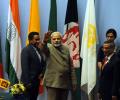
'If his three priorities are the economy, the economy, the economy, then there is need for a stable region, a stable neighbourhood.'

The United States has asked China to "immediately" return its unmanned naval probe in international waters in the South China Sea which it alleged has been "unlawfully" seized by them.
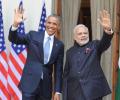
Modi and Obama surely put India-US ties in fast-forward mode. But 5 things deserve careful attention.

"It's ironic that Modi visited Tokyo a few days ago and talked about China's expansionism. The key now will be to get beyond such unnecessary controversies and start afresh.'

At the Paris climate change summit, there is talk of restricting temperature rise to 1.5?C instead of 2?C, which has been negotiated so far. This would give India less space to grow by limiting carbon emissions further, reports Darryl D'Monte, reporting exclusively for Rediff.com from the French capital.

Considering Modi's style of practicing diplomacy, it is likely that a clear message would be conveyed to China that it is high time Beijing stops using its good relations with Pakistan as a pressure tactic against India. This is imperative not only for strengthening India-China relations at the bilateral level but also for maintaining stability at the regional level, says Sana Hashmi.

The Wildlife Photographer of the Year, developed and produced by the Natural History Museum, London, announced its winners for 2016 and we guarantee you that these images will blow your mind.
Seeking to boost the strategic ties, India and the US finalised the text of the Logistics Exchange Memorandum of Agreement.

Here are some of the best photographs clicked across the globe in the month of October.

Defence Minister Manohar Parrikar and outgoing United States Defence Secretary Ashton Carter on Thursday finalised the "major defence partner" status to India which will fast-track cooperation and sharing of high-end American defence technology.

New Delhi remains a priggish suitor to Washington's overtures, but it has begun appreciating potential tech benefits to ties with the US.
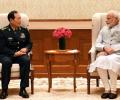
'China's military is expected to deploy full throttle its new equipment including J-20 stealth fighters, drones, medium range missile systems, surveillance and others to continue to put psychological pressure on India,' warns Srikanth Kondapalli, Professor in Chinese Studies, JNU.
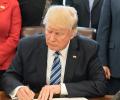
India needs to consider whether the Donald Trump administration can actually deliver, observes former foreign secretary Shyam Saran.

At a time when Donald Trump is making belligerent noises, Chinese President Xi Jinping responds by overhauling the People's Liberation Army and restructuring the command of the PLA Navy to emphasise Beijing's resolve to dominate the South China Sea.
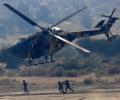
'Given the present force levels, India cannot fight and win.' 'India can't hope to terminate the conflict on India's terms and impose the nation's will upon the adversaries,' says Brigadier Gurmeet Kanwal (retd).

He said he has always maintained that instead of fighting with each other, India and Pakistan should together fight against poverty.
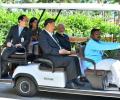
'Only when China treats India as an equal can we consider them real friends.'

Here's your weekly digest of the craziest stories from around the world.

With Donald Trump the appeal has to be to his business instincts in which his personal interests seem to play a significant role, says former foreign secretary Kanwal Sibal.

At the summit, India signed the SCO's memorandum of obligations, kick-starting the process of its accession into the group as a full member.

'India alone cannot walk the path of peace. It also has to be Pakistan's journey to make,' says Prime Minister Narendra Modi at the government's geo-political flagship initiative "Raisina Dialogue-II".

'Of all the areas that define the future for a strong US-India partnership, none is more important than our defence and security ties.'

'It is crucial today to realise where we have reached in this 15 year-period in order to fully and properly assess the profundity of what General Rawat has said,' points out Ambassador M K Bhadrakumar.
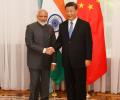
'The fact that Modi and Xi exuded confidence to accelerate the negotiations for a border settlement alone underscores that the Russia-India-China triangle has become very dynamic,' notes Ambassador M K Bhadrakumar.
'Both India and Pakistan are now, for the first time in history, very closely allied and connected with the US -- economically and politically.'

'New Delhi showed itself willing -- at least for a period -- to tolerate the risk of conflict and to withstand Beijing's implicit and explicit threats.' 'But it also continued to try to cut some kind of deal with China to reduce tensions.'

The differently-abled deserve a normal life. Nothing will stop Poonam Natarajan from ensuring that India, slowly but surely, gives it to them, discovers Shobha Warrier.

Australia's Prime Minister Tony Abbott on Friday said he will sign an agreement with India to sell uranium for non-weapon use. "Prime Minister Modi and I will today sign a nuclear cooperation agreement that will finally allow Australian uranium to India," he said while addressing a meeting, organised by industry chambers including CII and Ficci.
The Indian desire to deepen its ties with Vietnam, especially in the oil sector, besides defence and trade, was conveyed to the top leadership in Hanoi by External Affairs Minister Sushma Swaraj.

Prime Minister Narendra Modi on Tuesday said Australia will not be at the periphery of India's vision but at the centre of its thought, as he called for closer bilateral security cooperation and a comprehensive global strategy to tackle the menace of terrorism.

With the expected launch of The People's Liberation Army (Navy)'s second aircraft carrier on April 23, China will match India in carrier numbers.
'In these days of a communication revolution, was it necessary for him to go to every country?' 'Mahatma Gandhi had no internet or a twitter account, but the whole world recognised him as the greatest leader of the twentieth century,' says Ambassador T P Sreenivasan.

Asked if the relationship has achieved its full potential, the President replied, "Absolutely not."
China has demonstrated that it has the power to not be isolated, and it is likely to become more powerful over time.
